
Much has been written about founder syndrome: the founder who cannot let go, who centralises decision-making, struggles to delegate, treats an organisation as a personal possession, or stays long after the institution should have moved to new leadership. Founder syndrome is real. I have seen it. But having founded and helped build organisations myself, I have come to wonder whether we sometimes diagnose the founder without looking closely enough at the institution that grew up around them. Sometimes the question is not only, “Why won’t the founder leave?” It is also, “What happened when the founder tried to get others to carry the organisation, so that a timely and measured transition could take place?”
Like many founders, I started with an idea I believed in and went looking for people to build it with. Some joined the founding structure because they were senior, some because they were accomplished, some because they were friends or people I respected. At the time, those seemed like reasonable considerations. I understand differently now. Seniority does not tell you whether someone will show up. Accomplishment does not necessarily translate into stewardship. Friendship does not guarantee accountability. And an impressive name on a board is of little value if the person behind it lacks the time or willingness to help build an institution.
This matters especially in young nonprofits, where there is often little or no money, board members are volunteers, and the founder herself may earn nothing for years. Everyone is contributing, supposedly, because they believe in what they’re building. Yet a familiar dynamic can develop. People accept positions but behave as though the organisation remains the founder’s responsibility. Meetings become optional, commitments compete endlessly with “other things,” and some members come to see their role as periodically reviewing what the founder has or hasn’t done, rather than sharing responsibility for whether the organisation succeeds.
A founding board cannot behave like the board of a thirty-year-old institution with a full secretariat. In the early years, governance and institution-building overlap: there are systems to establish, relationships to cultivate, resources to mobilise and crises to solve. When several people have accepted that work but only one consistently shows up, responsibility migrates to whoever cares most whether the organisation survives. Usually that is the founder, not necessarily because she wants control, but because she cannot bear to watch the idea fail.
I remember needing board members’ signatures on a document that was crucial to a grant application. Everything else was ready. It took two months of follow-up to get them. I remember agreeing to hold more meetings than our constitution required, because members who had rarely attended asked for them and I wanted them to feel involved, even though I knew the extra load would fall on me. Then some of those meetings went ahead without the very people who had requested them. Twenty minutes in, a phone call would reveal that something else had come up. And when decisions were made in their absence, the objection was sometimes that they had not been included. None of this was dramatic. It was ordinary, and that is precisely the point. Repeated over years, small ordinary absences reshape an institution.
The cycle is simple. The founder delegates, and the task comes back unfinished. She follows up, and is met with explanations or silence. Then a deadline arrives, a donor is waiting or salaries must be found, and she does it herself. Eventually the organisation develops around her. She knows the donors because she had to cultivate them. She understands the finances because she had to ensure obligations were met. She holds the institutional memory because she was present for every crisis. Then one day people ask why everything depends on the founder.
It is a fair question, but an incomplete one. We should also ask how everyone else became so dispensable. Founder dependence can be created by a founder who refuses to share authority. It can equally be created by years of inconsistent participation and people accepting titles without the responsibilities attached to them. Sometimes what looks like a founder’s inability to let go began as everyone else’s willingness to let her carry it.
Nor is the founder blameless in that cycle. My own instinct to accommodate, saying yes to extra meetings, absorbing missed tasks, not insisting on what we had agreed, kept things moving in the short term but also taught everyone that the work would get done regardless. Rescuing an organisation repeatedly can quietly train it to depend on you.
In nonprofits, people sometimes treat voluntary leadership as though accountability were also voluntary. It is not. The absence of a salary or sitting allowance changes what can reasonably be expected, but it does not make a commitment meaningless. Circumstances change, and there is no shame in that: people face bereavement, new jobs, family demands, studies or illness. The problem is not changing circumstances but silent withdrawal. A short written note saying “I will be unavailable for these months; please proceed without me” allows an organisation to plan and makes clear that decisions taken in one’s absence are accepted. And sometimes good stewardship means saying, “I no longer have the capacity to serve this organisation as it deserves. Someone else should take my place.” That is leadership too.
Founders, then, must be more disciplined about whom they invite in. We sometimes recruit names when we need commitment, seniority when we need availability and a track record, friendship when we need competence. Before titles are given, we should have the uncomfortable conversation. What will you be responsible for? How much time can you realistically give? What happens if you repeatedly don’t deliver? If you no longer have capacity, will you step aside? Founders should also decide in advance how to part ways, with dignity, from those who cannot contribute, rather than leaving that question until it becomes a crisis.
There is a broader cultural point here too. We celebrate the person who starts something. We speak far less about the capacity to steward something you did not originate: to join someone else’s vision, bring your networks, judgement and labour to it, and treat its success as partly your responsibility. Many organisations struggle because too many people join as spectators. If the organisation struggles, it is the founder’s problem; if it succeeds, ownership becomes collective. Responsibility should not be individual in the hard years and shared only when there is success to claim.
This changes how we should think about succession. Founders must build systems, document knowledge, delegate real authority, and develop other leaders. But someone must also become capable of receiving what the founder is asked to release. You cannot insist that a founder delegate while showing, repeatedly, that delegated work will come back undone. Succession is not only the founder’s responsibility to let go. It is also the institution’s responsibility to become capable of being let go.
This is why co-stewardship matters well before any transition is announced. A handover is credible to funders, partners and the communities an organisation serves only when they can already see others carrying real responsibility: board members who hold donor relationships, oversee programmes and take decisions without waiting for the founder. Each responsibility that someone else genuinely takes on brings the transition closer. Each one that comes back undone pushes it further away. Co-stewardship, then, is not only about lightening the founder’s load today. It is how an organisation earns the confidence of those watching that it can survive tomorrow, and how a founder is able to leave on time rather than too late.
So yes, let us ask whether a founder has become controlling, whether decision-making is too concentrated, and whether she knows when to leave. But let us also ask whether the board showed up, whether people fulfilled what they accepted, and whether the founder was surrounded by co-builders or spectators. Sometimes an organisation has founder syndrome. Sometimes it has a co-stewardship problem. Often it has both.
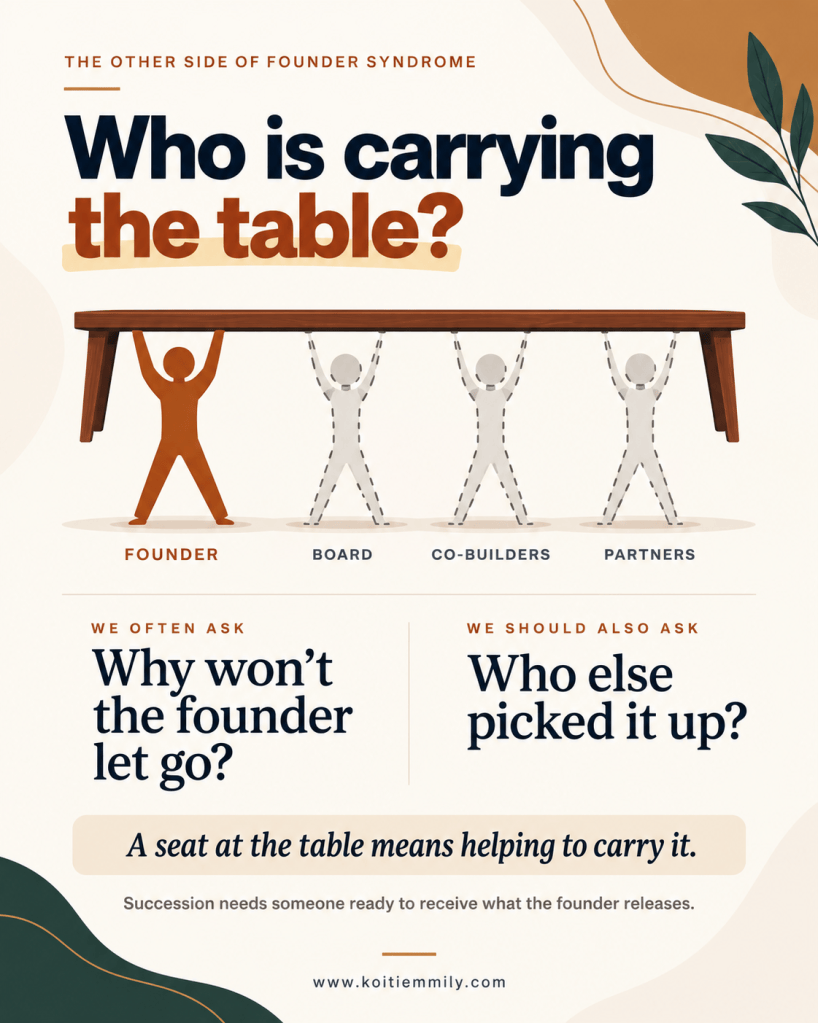
The healthiest organisations eventually become bigger than their founders, not simply because founders learn to leave, but because they build people and systems capable of succeeding them, and because those who build alongside them understand that taking a seat at the table means helping, in good faith, to carry it. Perhaps we should spend as much time teaching people to be good stewards of someone else’s vision as we spend teaching founders how to let go.

