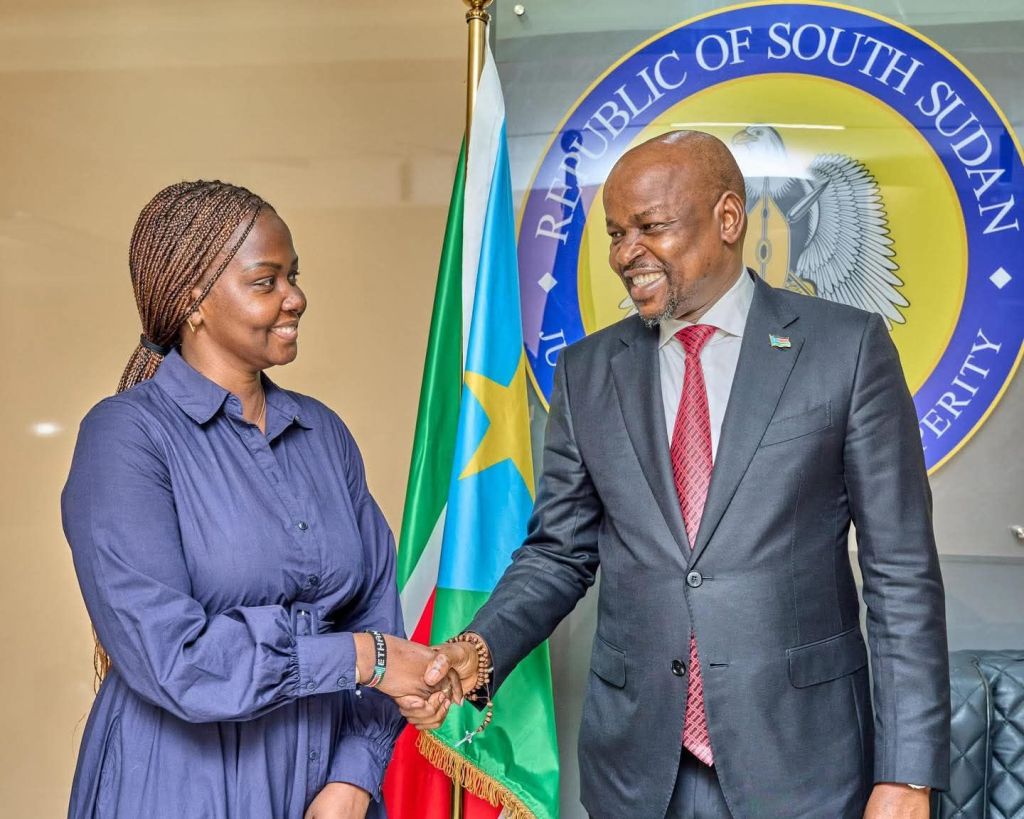
Ms. Adut Salva Kiir, the new Senior Presidential Envoy on Special Programs meeting Dr. Benjamin Bol Mel, the Vice president for the economic cluster within a week of assuming office.
On 20th August 2025, the president of the Republic of South Sudan appointed his daughter Ms. Adut Salva Kiir as the Senior Presidential Envoy on Special Programs (SPESP). Since that day the, the public has heard little beyond the fact that she is the President’s first daughter and founder of Adult Salva Kiir (ASK) foundation. Her speeches have been scarce and, when offered, only hint at fragments: that she was born in hardship, that her struggles were part of the broader liberation struggle, and that she has an economic background. Admirable, yes, but woefully inadequate. These scraps do not amount to the kind of story that inspires a generation.
Sadly, this is not unique to her case. For most appointments announced by presidential decree, the media houses limit themselves to headlines:“𝐒𝐨-𝐚𝐧𝐝-𝐬𝐨 𝐚𝐩𝐩𝐨𝐢𝐧𝐭𝐞𝐝.”Little effort is made to go further. The public is rarely given a deeper understanding of the appointee. Their academic path, their track record, their professional contributions, and their worldview are not shared. Instead, we are left with names and hometowns, as though that alone should qualify someone to lead. The result is that people forget that leadership requires more than lineage, connections, or geography. It demands competence, vision, and experience.
When the media does not probe, society pays the price. A girl watching on television, or scrolling on social media, yearns to know not only the title but the journey. What studies shaped her? What obstacles did she overcome? What mentors, disciplines, or defining moments prepared her for this role? These are the details that plant seeds of possibility. Without them, leadership is reduced to titles, not lived merit.
The absence of information does not only rob inspiration, it undermines accountability. Leadership is not just about who you are related to; it is about the qualifications, discipline, and vision you bring to a role. Without critical questions from and answers dug by the media, the public cannot assess whether a leader has the requisite skills or even the basic qualifications for the task. In failing to demand answers, both governance and the standards by which leaders are judged, are weakened.
But the silence is not the media’s alone. Those who claim to have known her since childhood, who have since been busy building support camps in her name, have offered no meaningful insight either. They too perpetuate the gap, preferring loyalty and praise over truth and detail.
And the leader herself bears responsibility. For women especially, telling one’s story comprehensively is not a luxury; it is a duty. When women ascend to high office but fail to share their journeys in ways that are authentic and complete, they deny younger generations, particularly girls a roadmap. The result is a leadership figure who feels distant, inaccessible, and uninspiring.
Leadership is not just about occupying a seat. It is about embodying a story that teaches, inspires, and sets standards. The media must do its job to probe and narrate. Leaders must embrace the duty of authentic storytelling. And as a society, we must demand both. For when stories remain untold, we do not only lose inspiration, we lose accountability, and we allow power to rest on titles alone.
Yesterday, I was privileged once again to take the pulpit during my local church’s Sabbath service. It was the global #EndItNow Emphasis Sabbath, an annual moment when Adventist congregations worldwide confront the scourge of abuse in its many forms. This year, the spotlight fell on a group often forgotten until their frailty becomes unavoidable; the elderly. Stewarded by women’s ministries across the globe, it was a call not just to awareness, but to repentance and action.
The memory text came from 𝐄𝐱𝐨𝐝𝐮𝐬 𝟐𝟎:𝟏𝟐 “Honor your father and your mother”, and the sermon was titled “𝐀𝐛𝐮𝐬𝐞 𝐨𝐟 𝐭𝐡𝐞 𝐄𝐥𝐝𝐞𝐫𝐥𝐲: 𝐇𝐨𝐧𝐨𝐫 𝐘𝐨𝐮𝐫 𝐅𝐚𝐭𝐡𝐞𝐫 𝐚𝐧𝐝 𝐘𝐨𝐮𝐫 𝐌𝐨𝐭𝐡𝐞𝐫.”Jesus Himself reinforced this command in 𝐌𝐚𝐫𝐤 𝟕:𝟓–𝟏𝟑 , when He rebuked the Pharisees for upholding tradition as an excuse to abandon their parents. By extension, He rebuked every generation tempted to treat the old as burdens instead of blessings.
I must acknowledge that this sermon was not my own original creation. Like countless other Adventist preachers yesterday, I paraphrased the wisdom penned in 2007 by two remarkable women leaders: 𝐇𝐞𝐚𝐭𝐡𝐞𝐫-𝐃𝐚𝐰𝐧 𝐒𝐦𝐚𝐥𝐥, now departed, and 𝐑𝐚𝐪𝐮𝐞𝐥 𝐀𝐫𝐫𝐚𝐢𝐬, still faithfully serving. Their foresight then has become, in our time, an urgent intervention. For this I am profoundly grateful.
In preparing to preach, I could not escape a deep, uncomfortable reflection: how have I treated the elderly entrusted to my life? There are moments I am proud of, times I have protected, helped, or simply listened. But honesty compels me to admit there are also moments of neglect.
There have been days when I delayed returning calls from my mother, father, or uncle, even when I knew they reached out simply to connect. I have older friends who have accompanied me faithfully in my career and spiritual journey, yet more often than not it is they who initiate the call, not me. On the surface these lapses may seem small, but they are not. To ignore the communication of elders is to inflict emotional neglect. To immerse myself in a full day of church activity while failing to return an uncle’s repeated calls is, in its own way, a form of spiritual neglect. May God’s grace suffice where I have fallen short.
What Elder Abuse Really Looks Like? The 𝐖𝐨𝐫𝐥𝐝 𝐇𝐞𝐚𝐥𝐭𝐡 𝐎𝐫𝐠𝐚𝐧𝐢𝐳𝐚𝐭𝐢𝐨𝐧 defines elder abuse as any act or failure to act appropriately within a relationship of trust that causes harm or distress to an older person. Too often, we imagine only physical violence, but abuse takes many subtler forms. It can be financial exploitation, when resources meant for care are siphoned away. It can be emotional neglect, when phone calls are ignored and their voices are silenced. It can be social abandonment, when we treat them as invisible once they no longer provide materially. It can even be spiritual abuse, when religion is used as an excuse to deny help, like a child who claims all their income was “given to God” and therefore their parents must go without food or medicine.
Abuse also shows up in cultural attitudes. Too often the elderly are treated as irrelevant, boring, or a nuisance. Yet they are bearers of memory, wisdom, and dignity. They deserve conversation, companionship, and the assurance that their lives still matter beyond what they once owned or provided.
I have seen grandchildren unmoved by the poverty of grandparents who once raised them when their own parents were busy. I have heard young people boast that ensuring their parents live decently is “not their responsibility.” This is more than ingratitude; it is disobedience to the command to honor one’s parents.
Yet preventing elder abuse does not require monumental gestures. It begins with simple, deliberate acts: returning a call, asking about their youth, listening without rushing, or visiting not to showcase achievements but simply to share presence. Even the act of checking in on a friend’s parents, especially when distance keeps their child who’s one’s friend away, can warm an elder’s heart and affirm that their child has built meaningful relationships. During festive seasons, rather than reducing visits to mere displays of success, we can choose instead to spend quality time, characterized by real conversation and genuine attention.
For communities, congregations, and workplaces, intentional recognition also makes a difference. Imagine dedicating a day each year to celebrate the elderly, inviting them to lead an activity with the support of younger members, and creating intergenerational spaces where they are not just present but central. Such practices are simple but deeply restorative.
For Christians, honoring the elderly is not a suggestion; it is a command. 𝐋𝐞𝐯𝐢𝐭𝐢𝐜𝐮𝐬 𝟏𝟗:𝟑𝟐 is unequivocal: “Stand up in the presence of the aged, show respect for the elderly and revere your God.”To dishonor the old is, ultimately, to dishonor God Himself. The chilling story of the prophet Elisha in 𝟐 𝐊𝐢𝐧𝐠𝐬 𝟐:𝟐𝟑–𝟐𝟓 reminds us that when the young mock or mistreat the old, heaven itself may intervene. God defends the elderly even against the arrogance of youth.
And for those who do not share this faith, the truth remains: age beckons us all. If we do not die young, we too will grow old. The scripts we write today in how we treat the elderly will one day be replayed by our children when they watch us grow frail.
Let me end this reflection to do what I failed to do earlier last week which is returning the calls of my uncle who’s in his late seventies, had phoned me three times last week and once today already. I haven’t returned his calls. Often, he just wants to know how I am. That is his way of showing love. My silence denies him that joy. That is my neglect, and I must repent of it.
Friends, let us pause and ask ourselves: Whose call or presence have we ignored? Whose dignity have we overlooked? Whose wisdom have we silenced? Old age is not a burden to be managed, but a crown of experience to be honored.
May we not wait until it is too late to learn this truth.
A few weeks ago, I met a highly educated Junubi lady at a beauty parlour. I had seen her before in professional spaces connected to work I had done in the past, though we were never friends, nor did we share mutual friends. As is my habit with acquaintances, I greeted her politely and then sat down to get my nails done.
After a while, she turned to me and asked, “Which hospital do you work at? By the way, I don’t know where you work or what you do. Which doctor are you?” She knows from meetings in the professional spaces that I am a doctor. She asked with a dismissive look. Her words unsettled me. Not because curiosity is wrong, but because the phrasing carried little courtesy or respect.
Over the years, I have often encountered similar interactions, usually from Junubin, and often women, where the opening line is, “By the way, I don’t know what you do,” without first talking about themselves to make the other person not feel weird. Each time, I am left feeling diminished, or interrogated. Unless I extend compassion and remind myself that perhaps the person simply lacks the finesse of good communication for networking, the moment feels more like a dismissal than a genuine interest.
Such openers may sound harmless, but they carry undertones of condescension. They suggest that the other person is yet to prove their worth, as if curiosity is a license to pry without first offering respect. The result is poor networking. The one asked feels unsafe, and the one asking appears unskilled in people relations.
A more graceful way to know what an acquaintance or stranger does exists. Start with yourself: “I work in this field and I’m curious about what you do nowadays.” Or, “I’ve heard a little about your work and would love to know more.” This transforms the conversation into an exchange rather than an interrogation. Networking, after all, is not about cornering people with blunt questions. It is about cultivating trust through humility, courtesy, and genuine interest.
As for me, the next time someone asks in that manner, I may not extend silent compassion. Instead, I will gently but firmly ask: “Why do you phrase your question in a way that feels dismissive? Is that how you would want to be asked about your work, and how would you feel?” On good days, I will respond with, “Thanks for asking. How about we start with you. What are you doing with your life nowadays?” For sometimes, wisdom is not in enduring poor manners quietly, but in helping others see how to do better.
This evening, I read the opening remarks by Dr. Tedros Adhanom Ghebreyesus, Director-General of the World Health Organization, at the Africa Health Sovereignty Summit held today in Accra, Ghana. The summit seeks to redefine African health governance and health systems sustainability leadership. While reading, I found myself deeply moved by both the urgency and clarity of his message. His words resonate profoundly, especially at a time when sharp aid cuts are becoming the common denominator across international development and humanitarian sectors. For fragile nations like South Sudan, the implications are far-reaching.
In his address, Dr. Tedros made several bold but necessary assertions, ones that offer a practical blueprint for African health systems to stand on their own feet. Among his key points, four struck me with particular force:
The responsibility for financing strong, resilient health systems rests with governments.
The most efficient and equitable source of health financing is the national budget.
More money alone is not enough. What matters is how effectively that money is used.
In many low- and middle-income countries, health budgets go unspent due to weak public financial management systems.
As a South Sudanese professional engaged in global health leadership and advocacy, I welcome these calls. They are not only timely but essential. And yet, I must add, with the same urgency, that none of these shifts are achievable without a corresponding transformation in governance.
Sovereignty Cannot Exist Without Accountability
There is no health sovereignty where citizens are unable to question how their taxes are spent, where decisions about resource allocation are made in darkness, or where data is not reliably available to guide policy. If governments are to finance their own health systems, as they must, then transparency, accountability, and civic participation are non-negotiable.
Sovereignty, in the truest sense, must be people-centred, and that includes the right of citizens to engage in policymaking, to demand value for money, and to insist that health spending reaches those who need it most. Without this, sovereignty becomes a hollow term, a banner under which inefficiency, exclusion, and elite capture are allowed to thrive.
Financing Without Good Governance Is Futile
Many meetings have long discussed domestic resource mobilisation and country ownership in development discourse. These are noble goals. But in many fragile and conflict-affected settings, health budgets remain underspent not due to lack of funds, but due to the absence of systems that are capable, responsive, and accountable. Weak procurement systems, delayed disbursements, political interference, and poor coordination continue to sabotage even the most well-intentioned efforts. This is what defines the weak public finance systems mentioned by Dr. Tedros.
In South Sudan, for instance, we have witnessed how donor dependency distorts national priorities and delays urgent reforms. Yet we have also seen how fragile the prospect of local ownership becomes when governance systems are not equipped to manage or absorb funds efficiently. Health workers go unpaid, medical supplies are mismanaged, and communities lose faith. More disturbing is that lives are lost.
This is not simply a health sector issue. It is a governance issue.
Seismic Shifts in Political Will Are Surely Needed
If Africa is to realise the health sovereignty that Dr. Tedros so eloquently advocates for, it must be matched with a seismic shift in political will, one that opens up civic space, strengthens institutions, and ensures governments are accountable to their people.
We cannot make promises at high level summits about strengthening health systems while stifling dissent. We cannot preach efficiency while ignoring corruption. And we cannot champion inclusion while excluding local actors and communities from decision-making.
Health sovereignty is not just about money. It is about who holds the power to decide how health systems are built, maintained, and sustained, and whether that power is exercised in the public interest.
As we respond to these calls for national investment and local ownership, let us not overlook the indispensable role of democratic governance. We must advocate not only for more domestic financing, but also for the political conditions that allow those resources to be used effectively, equitably, and accountably. This is the indisputable prerequisite for health sovereignty.
Only then will the vision of health sovereignty become a lived reality across Africa. Only then will the response to global aid cuts be a dignified one.
In a country where despair often overshadows hope and institutions too frequently falter in their responsibilities, there are quiet revolutions happening, led not by officials in high office, but by everyday citizens who decide they will not wait. I recently witnessed one such revolution in Gudele Block 9, a residential stretch on the outskirts of Juba, South Sudan.
A Different Kind of Independence Day
It was an ordinary afternoon on June 18th, 2025, when two unexpected visitors knocked on the gate of our organisation’s office in Gudele Block 9. As I was informed they were local youth seeking to speak to the head of the NGO, I’ll admit that a sliver of apprehension crossed my mind. But I stepped out, greeted them, and invited them in.
What followed was a deeply humbling conversation, one that revealed how a group of young people has transformed their community through sheer will, collaboration, and vision.
Youth Organising for Change
The young men had come to raise funds for an upcoming Independence Day celebration. Not a city-wide event, not a grand affair, just something to unite residents in their neighborhood. They wanted to foster community spirit, to encourage togetherness among people who, too often, live as strangers behind high compound walls.
They had no formal budget in hand because they had left it at their office. They had only a request: would our organisation contribute? Myself and a colleague listened with interest, and as they spoke more, we grew increasingly curious about what else these youth were doing.
Here’s what they’ve achieved so far:
Road Rehabilitation: Organised residents to raise funds and partner with local government to grade and repair a key access road.
Festive Celebrations: Decorated the entire stretch of Gudele Road to mark New Year 2025, enhancing community spirit.
Garbage Collection: Set up a community-funded waste collection system with support from the city council.
Greening Initiative: Planted 23 trees along community roads to improve the environment, despite setbacks with a few trees.
Vision for the Future
What struck me most wasn’t just what they had done but what they hoped to do next:
Install street lights to deter criminal activity.
Facilitate intergenerational dialogues between elders and youth.
Build a community-based security model where all residents are known and accounted for.
When Government Falls Short, Communities Rise
I asked them a simple question: why not demand that the government do all this? Their answer was sobering. “The authorities just talk and deliver air,” one said. They recounted how the mayor promised to financially support their road rehabilitation but never delivered. Yet, he turned up for the ribbon-cutting with cameras in tow.
They hold no bitterness. But they are convinced that the future of their community lies in the hands of its residents, not its politicians.
Bridging the Gap: Where Hope Meets Policy
As I listened, I couldn’t help but think of the bigger picture, how such local initiatives could address some of the most difficult problems we face, including gang violence and sexual assault.
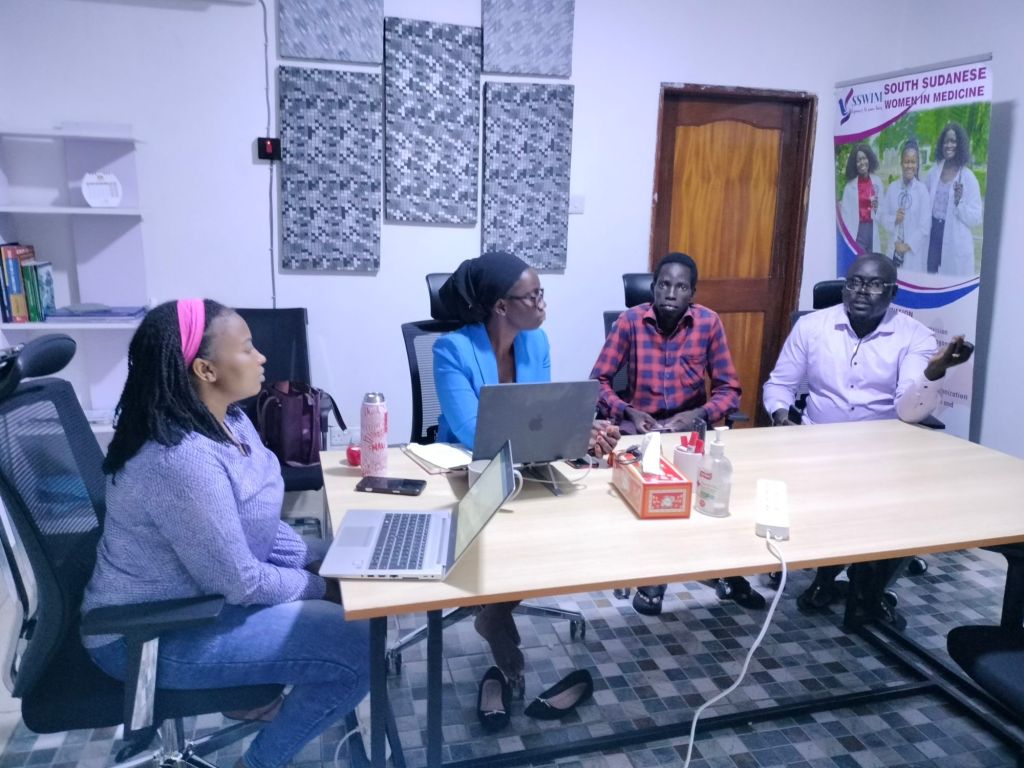
What if youth like these were supported to facilitate community dialogues on safety, gender-based violence, and accountability? What if their structures could be leveraged for public health campaigns such as the promotion of the new PCV and Rotavirus vaccines that South Sudanese Women In Medicine (SSWIM) has been working on the past months? What if WASH interventions were piloted in these self-organised neighborhoods? What if young people didn’t only carry bricks to fix roads—but also carried their voices into policy platforms?
Tribal Unity in Action
Another element of their story that inspired me was their unity across ethnic lines. One of the youth was from the Bari community, the other from the Dinka. Their collaboration wasn’t presented as anything extraordinary, it was simply what needed to be done. But in a country still struggling with inter-communal tensions, this quiet cooperation is nothing short of revolutionary.
A Call to Support, Not Supplant
For development actors, policymakers, women, and youth-serving organisations, the message is clear: our role is not to replace community agency, but to support, learn from, and scale it. Gudele Block 9 doesn’t need saviors. It needs partners. It needs recognition. It needs policies and funding that don’t extinguish community-led initiatives with bureaucracy or politics.
At a time when the narrative of South Sudan often feels dominated by what’s broken, these youth remind us of what’s working, and what could be replicated. They remind us that amidst the noise, there are quiet victories worth amplifying.
From Local Sparks to National Flame
As I write this, the youth of Block 9 are preparing their Independence Day celebrations. They’ve offered our team a slot to speak on health issues, and we plan to use it to raise awareness about vital vaccines. But beyond that, I see something greater unfolding.
This is a call to rethink development, from something done to communities, to something done with and by them.
In a nation brimming with potential but burdened by cynicism, we owe it to ourselves to nurture every spark of hope. Because when communities like Gudele Block 9 rise, they carry the rest of us with them.
Let’s Pay Attention
Let’s show up, not with answers, but with listening ears, open minds, and a readiness to walk alongside. The future, after all, is already under construction, one neighborhood at a time.
Are you part of a youth group or local government office or a non profit or private sector? Reach out if you’d like to collaborate with the Gudele Block 9 youth or explore how this model can be adapted in your area. Let’s build the future, together.
In every professional setting, whether a grassroots movement, a nonprofit collective, or a high-powered corporate boardroom, certain behavioural patterns quietly but consistently undermine progress. This is an observation I have made over the years while working on different initiatives. Some individuals join teams with enthusiasm, only to withdraw or obstruct when their ideas are challenged or their influence is curbed. Others are drawn not by the mission but by the magnetism of power, seeking status rather than substance. While their methods differ, both types often leave similar wreckage in their wake: confusion, stalled progress, demoralised teams, and missed opportunities.
Take the case of Michael, a seemingly committed team member in a regional health campaign. At the outset, he was vocal, eager, and always present. But when the team collectively decided on a different outreach strategy than the one he proposed, Michael grew distant. He began missing meetings, citing sudden travel or urgent obligations elsewhere. When reached, he would offer vague promises to “circle back” or “review things later,” though deadlines came and went without his input. When he did resurface, it was usually with objections, never paired with constructive suggestions, just enough to stall decisions and send the team in circles. Slowly, a pattern emerged: Michael showed up most when the project seemed on the brink of collapse, ready with just enough knowledge and flair to “save” the day, reinforcing his perceived indispensability.
This behaviour is not uncommon. Such individuals; what we might call quiet saboteurs, thrive on the illusion of being essential, but only when their dominance is unchallenged. When their ideas are overridden or when others rise in influence, they disengage in subtle, plausible ways. They do not openly resist; they quietly manipulate by delaying, obstructing, and complicating. Their arsenal includes strategic unavailability, performative busyness, and timely interjections that destabilise rather than enhance.
The toll of such behaviour on teams is significant. Progress slows, morale wanes, and trust disintegrates. Other team members find themselves scrambling to fill gaps, resolve avoidable complications, or rework deliverables that would have otherwise been completed efficiently. Over time, the team begins to second-guess itself, anticipating obstruction even in straightforward matters. Meanwhile, the saboteur robs themselves of growth. By refusing to engage honestly with challenges or collaborate respectfully, they miss opportunities to deepen their skills and earn genuine respect. The pressure of maintaining a facade of relevance eventually breeds stress, resentment, and isolation.
Then there are the Empty Thrones; individuals who seek positions of authority but flee from the responsibilities those roles demand. Consider Agatha, a founding member of a women-led advocacy group. She insisted on being named chairperson and frequently reminded the team of her seniority and experience. Yet, she rarely prepared for meetings, seldom followed through on action points, and often deferred decisions to others under the guise of “delegating.” When the team produced a well-researched policy brief that attracted media attention, Agatha rushed to be the face of the success, speaking publicly as though she had led the effort. When feedback came suggesting improvements to the group’s internal processes, she was the first to criticise the “lack of coordination” and point fingers to others, never herself.
This behavior, too, is familiar. Such individuals are drawn to the prestige and visibility of leadership but not the accountability it demands. They conflate being in charge with being above reproach and often assume that their presence alone qualifies as contribution. They resist learning, avoid hard conversations, and invest little in their teams’ development. Their sense of entitlement is rarely matched by competence or consistency.
The damage they do is no less profound. Teams become directionless, roles blur, and contributions go unacknowledged. Those who work hard behind the scenes feel unrecognised or worse, overridden. Innovation is stifled when those with ideas fear criticism from disengaged yet vocal figureheads. And as for the empty-throne leaders themselves, their reputations gradually tarnish. Peers begin to see through the performative leadership. New opportunities bypass them in favor of those who have proven substance behind their stature.
Collectively, the actions of saboteurs and figurehead leaders exact a heavy cost. Organisations lose momentum. Team culture erodes. High performers often burn out or leave. Promising initiatives stall for reasons that have little to do with capacity or resources, and everything to do with interpersonal sabotage and leadership voids.
But there is an alternative; an emotionally intelligent way of working that centers integrity, empathy, and shared purpose. It begins with self-awareness. Those who sincerely wish to grow must routinely reflect on their behaviour: Am I contributing or controlling? Am I reacting to challenge with withdrawal or with curiosity? Am I hiding behind excuses or showing up honestly, even when things don’t go my way?
Accountability is equally vital. Professionals must commit to doing what they say they will do, and communicate proactively when things change. Rather than manipulating perceptions to appear overburdened or irreplaceable, it’s far more constructive to acknowledge limits, request help when needed, and keep the team informed. This builds trust far more than grandstanding ever could.
Constructive communication must replace subtle sabotage. Raising concerns is healthy but only when it comes with solutions or a willingness to respectfully help implement change. Criticism, when offered, should be respectful and specific, aimed at building rather than belittling. And true leadership, regardless of title, must be rooted in service. The best leaders measure their success by the confidence, competence, and cohesion they foster in their teams.
Finally, continuous learning must be a hallmark of any professional who hopes to grow in influence and effectiveness. Leadership is not a reward; it is a daily practice. Those who commit to learning, to staying curious, and to modelling humility become not only more capable but more inspiring.
In the end, what a team achieves is not merely the product of resources or strategy; it stems from character and culture. While saboteurs and empty-throne leaders may temporarily wield influence, it is the emotionally intelligent, humble, and consistently present professionals who make a lasting impact. They build trust, inspire commitment, and drive teams to deliver not just outcomes but true transformation. As challenging as it may be at times, let us all confidently choose the emotionally intelligent path that leads to meaningful change.
Dear Christian, 2024 has been a year you can describe using any adjective as you see fit per your personal experiences. For me, it has been a year that has strengthened my resolve to embrace my limitations while doing everything I set out to do even when afraid. It has been the year that has reminded me that I am capable of leading myself through crisis and counting triumph even when someone else sees failure. It has been an affirming year.
2025 is beckoning us over. When we cross over, I pray you remember that beyond what you think of yourself, you are God’s masterpiece created in His image (Genesis 1:27) and that you are fearfully and wonderfully made (Psalm 139:14).
When we cross over, I pray that throughout 2025, you remember that beyond the plans you make, God has intricate plans for you (Jeremiah 29:11). That the plans are not for destroying you but to prosper you to fulfil your mission on earth.
When we cross over, I pray that throughout 2025, you remember that because you are a sinful human, your emotions will fail you often and your heart will harbour deceitful and wicked desires (Jeremiah 17:9). Because of this, even when you pursue righteousness on your own accord, even what is deemed as your most righteous deeds will appear as filthy as a rug to the courts of heaven (Isaiah 64:6)
When we cross over, I pray that throughout 2025, because you will remain aware of your fallibility as a human, that you remember to embrace God’s perfect will and place your trust in Him for all your endeavours ( Proverbs 3:5-6). Remember that when your human will unites with the will of God, great things can happen because it is God who will inspire you to will to do good (Philippians 2:13)
When we cross over, I pray that you will not be surprised by obstacles, not being helped by those you had hoped to help, betrayals becoming imminent or looming around you, doubt about you succeeding in something intimate with your life’s purpose attempting to cloud your mind, misrepresentation of your truth, casting of aspersions on your character, your credit being given to another, your reward being delayed, and being rejected, among others.
When we cross over, I pray that because the hardships mentioned above are the realities of life’s path, that you remember the biblical parable about the wicked vinedressers that climaxed with Jesus saying, “the stone which the builders rejected has become the chief cornerstone (Luke 20:17).
When we cross over, I pray that throughout 2025, when you become weary about your name not being mentioned in rooms, at tables and in halls of fame as you expect, that you remember the assurance in Luke 19:40 that God’s plans for you and all earth will be fulfilled even if many keep silent or fold hands because God can use stones to make it happen. I pray that with this you remember to not be threatened by bridges lost or burnt.
When we cross over, if you are a leader who is managing teams to build something, I pray that you remember to take to learning a lot from Nehemiah s story of rebuilding Jerusalem’s walls and what he had to deal with and how electing to be a good steward of his privilege and favour and wisdom of God led him through it all (Nehemiah 1-8)
When we cross over, I pray that throughout 2025, should you have a moment of triumph or loss, that your faith suffices to afford you living with gratitude. That you remember to be thankful always and look out for even the simplest things to be grateful for (Philippians 4:4) and do so before God (Psalm 100:1-2) and make Thanksgiving a habit (Deuteronomy 16:15.).
Ultimately, when we cross over, I pray that throughout 2025, you remember to take to tapping into the priceless counsel and wealth of scripture to understand circumstances around you and be guided in fulfilling your life’s purpose.
I pray for you a gratitude-filled and, faith-filled 2025 in which you will only be preoccupied with your contentment with God’s perfect unfailing will.
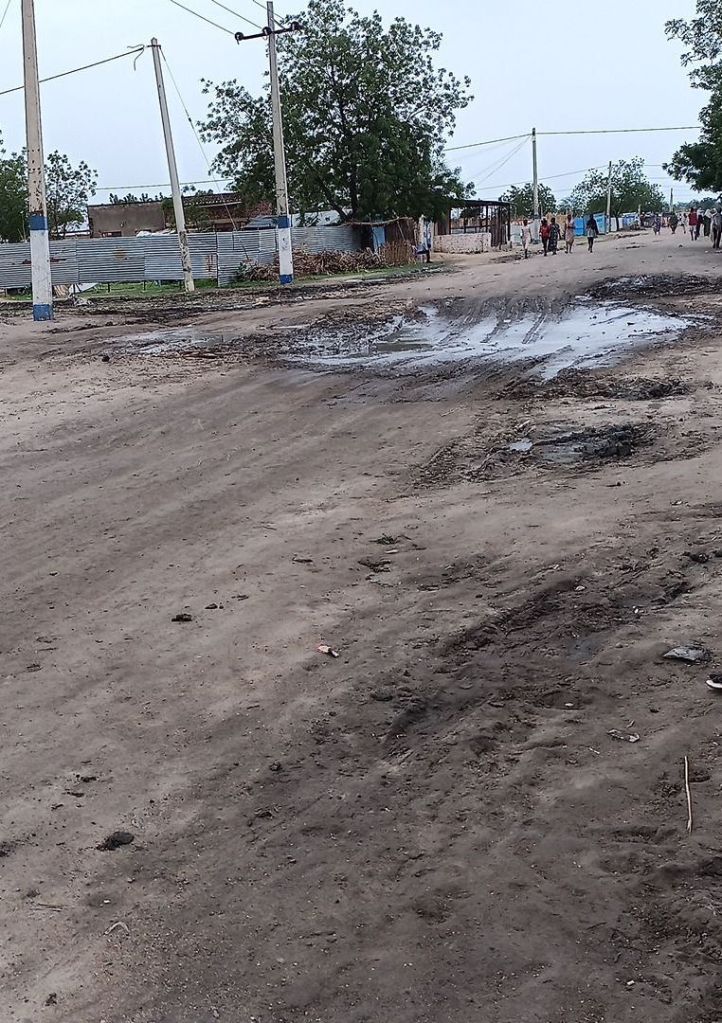
A street in Renk County, in a residential area a week after heavy rain in July 2024
This year’s International Toilet Day, 19th November, finds South Sudan grappling with a cholera outbreak that started in Renk, Upper Nile State. Since Sudan’s senseless war erupted in March 2023, Renk has been the major border town where refugees and returnees fleeing from the war arrive at and transit to refugee camps and ancestral homes respectively. Renk has also had to receive internally displaced persons from inter-communal conflicts in places like Malakal. As a result, Renk has had to suffer stress from sudden population upsurge due to influx of forced migrators.
Having lived and worked in Renk county this year (though for what I consider a short time) as a medical doctor, I witnessed first hand the water and sanitation crisis exacerbated by the influx of refugees and returnees. Although most of Renk county’s residences have ventilated pit latrines or toilets, there is normalised open defecation by children. It is not uncommon to find a child comfortably squatting in the middle of an often not busy street (with minimal movement of locomotives) and defecating what is almost always loose feces as their parent or guardian looks on.
Renk has enjoyed a piped running water system for many years as a border town but it is old and not well maintained. As a result, it cannot relay water to all homesteads that are connected to it. Consequently, for all homes in Renk town to have water, some people use donkeys with metallic 250 litre drums tied to the animals’ backs to fetch water from a point where it is easily gotten. They then distribute it at a fee to homesteads that either don’t get water from the piped system though connected to it or those that are not linked to it at all. At the time I was in Renk in July, a 20 liter jerrycan cost 400-500 South Sudanese pounds when the dollar rate was 3500 SSP to 1 United States dollar.
Renk’s soil is deeply cracking clay which makes it have low permeability thus flood-prone and takes long to dry up during the rainy season. Because clay soil is also tightly packed and difficult for water to infiltrate or move over it easily, the water tends to pool on its surface. Pools of stagnant water are therefore common in Renk during the rainy season and it’s from these with a semblance of settled water by the only tamarc road-side that car washers fetch to promote their livelihood. It is these same pools where the female anopheles mosquito that transmits malaria multiplies best.
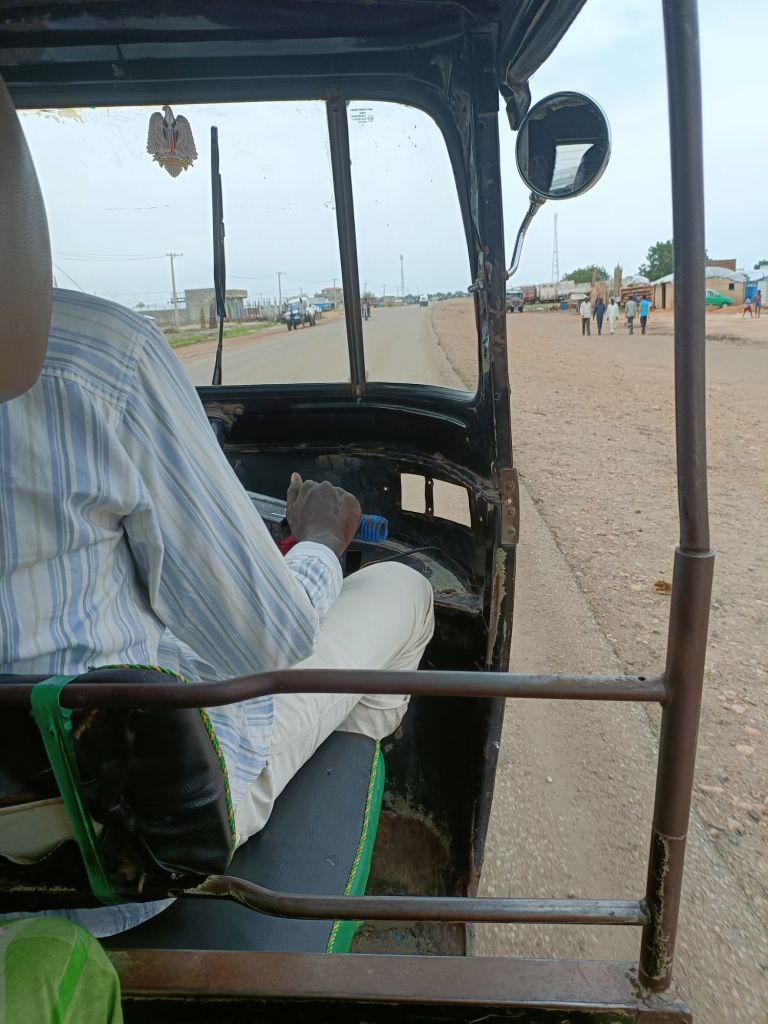
A raksha riding on the only tarmac road in Renk. Tarmac enters Renk from Sudan’s border.
Inside the refugee transit site, until August when I last checked, water pools would be common due to heavy rains. There are ventilated pit latrines but the population is often big compared to their number thus maintenance of hygiene is difficult. This exacerbates the cycle of diarrhoeal infections as houseflies multiply from the latrines, find their way to the dormitories of the refugees and food stalls just outside the transit sites. When these flies land on food that ends up being eaten, the pace is set for diarrhoeal illness to ensue. The cycle becomes vicious once the sick one with diarrhoea defecates in the open during rain as this would wash it off into the stagnant water trapping spaces that also serve as water sources for some in the community.
It is also worth mentioning that the latrines in the transit sites are not separated according to gender. As a result, in the past, some cases of attempted rape happened when women and girls went to unisex latrines only to find their perpetrators waiting for them. However, this has over the months been attenuated by one of the NGOs, ACTED, maintaining patrols all over the transit camp to guarantee the safety of all. That a water and sanitation crisis can result in sexual violence in the transit site adjacent to a town I have come to believe is one of the safest for a woman to walk on its streets is worrying. Compared with Juba, gunshots are unheard of in Renk town and its streets have lights that afforded me a lone walk in the night as late as eleven o’clock, something I cannot attempt in Juba.
To address the water hygiene challenge in Renk, Solidarite, a non-profit working in Renk has taken on water purification for both the town and the transit centers. However, in the transit centers, it is not rare to find people fighting at the water distribution points because of the long queues. Solidarite’s distribution point for the town also until August (not certain about now), wasn’t connected to the pipe system hence was one of the collection points where the metallic-tank laden donkeys would pick water from before heading for sale to the town dwellers. Often, the distributors of water don’t wash the tanks and in the process, what is supposed to have been treated water from Solidarite, is contaminated yet most consumers do not boil it before drinking.
With all the above, it is clear that Renk’s water and sanitation status is a notable prelude to not only infectious disease outbreaks like Cholera but also water-access-related conflict in the transit sites. As a clinician, it also made sense to me why most outpatient cases of children and adults attended in the transit sites were attributable to malaria and diarrheal illness.
Elsewhere in Juba, South Sudan, Eye Radio reported about a fortnight ago about people using polythene bags to ease themselves in the slummy suburb of Nyakuron East residential area. The lack of proper toilets or latrines in South Sudan is therefore a nationwide problem that must be addressed holistically.
This year’s theme for International Toilet Day; “Toilets – a place for peace” is therefore very relevant to South Sudan as she grapples with her most recent major public health threat; cholera, which I argue, can be linked to the effects of Sudan’s war on South Sudan. This year’s theme emphasises the relationship between sanitation and peace and security of communities. With a cholera outbreak that is now spread to other parts of the northern South Sudan, in a country whose rank on the peace and security index is wanting, Renk’s people are not at peace and by extension in the spirit of Ubuntu (I am, because you are), neither are any others across South Sudan.
As we mark this International Toilet Day, let’s recognise that the pursuit of peace and security in not only South Sudan but also the horn of Africa where Sudan falls, is inextricably linked to alleviation of the water and sanitation crisis in the same region. More investments by development and humanitarian partners should be intentional in embracing a humanitarian-development-peace nexus lense when addressing the WASH crisis in the horn of Africa and in particular South Sudan that is home to many refugees from Sudan.
Wishing you a thoughtful International Toilet Day.
Interior of renovated national parliament building captured by Lou Nelson courtesy of Eye Radio
Renovation of South Sudan’s national parliament building is already reported as a completed project by Eye Radio in one of its posts. As the shared photos on the radio’s Facebook page give South Sudanese social media users a sneak peek into the grandeur of it all, the first instinct of any patriot is celebration. However, a sobering truth looms soon after – the imperative for judicious use and meticulous maintenance to preserve this national treasure to reduce the frequent need for major yet costly renovations.
Under Eye Radio’s post, I lamented a recurring trend in a comment: the propensity to build magnificent structures only to neglect their upkeep, leading to premature deterioration and exorbitant renovation costs. This cycle of neglect must be broken, especially when it concerns a symbol as significant as our parliament.
Construction of any state-of-the-art edifices must be followed with matching stringent rules and protocols for use, alongside comprehensive awareness promotion and education. This also requires a matching budget. Yet, many of the esteemed legislators are likely unaware of financial implications of maintaining such a structure with a marvellous interior at least per South Sudan’s standards. Hence, ensuring they are well-informed and accountable in this regard cannot be overemphasised.
To cut the seemingly gordian knot, patriots can propose and demand that salary deductions which are specifically earmarked for periodic maintenance are introduced for Members of Parliament (MPs). One of their immediate sessions should legislate on the maintenance budget and such salary deductions. Directly involving MPs in the financial commitment required for the building’s upkeep will instill a sense of ownership and responsibility. After all, those who benefit from the privilege of occupying such an architectural marvel should also bear the burden of preserving it.
A second measure is to demand that the pressing need for basic education on the proper utilisation of modern amenities within the building is also addressed. There are obvious disparities in exposure and access among current MPs. While some may be well-versed in the nuances of parliamentary decorum and bourgeoise living, others may not. It therefore wouldn’t be unfair to consider that some representatives may lack familiarity with even the most rudimentary functions, such as modern toilet facilities and technological accessories in the building, among others. This underscores the urgency of comprehensive training programs to equip the MPs with the necessary skills to navigate and maintain their workspace effectively.
In pursuit of all the above, MPs must be implored that safeguarding the parliament building transcends individual or political affiliations. It is a duty they all must owe to the nation and future generations. Therefore, they shouldn’t just use it like poultry that walks in and out of a coop with the most significant activities as littering and noise making.
Ultimately, the MPs have an opportunity to redeem their collective image by considering the suggested proposals by any patriot. They can seize the moment for creating a legacy of responsible stewardship over a national symbol. Let their actions speak volumes about their commitment to building a brighter and sustainable future for South Sudan.
Young feminist women might hate to read this but I have to write it so that those who can, begin to manage their expectations and manoeuvring spaces with attendant opportunities. It is worth noting that this has likely been said before in different ways.
The older women you see dominating spaces or unintentionally mimicking the tokenism in inclusion exhibited in patriarchally shaped spaces, often have their leadership style modelled after patriarchal notions of leadership and this informs how they organise and acknowledge your existence. Like tea that often escorts whatever edible solid meal chosen for breakfast, ageism almost always accompanies the presence of patriarchy. Ageism personified, also has “the young can’t teach the old much” up its sleeves. You may be young, wise and gifted but to many who are older and shaped by these notions, you are seen more as one who should carry the handbag, serve them tea and be invited last to the table or even if you are invited early, it is often for such roles akin to those of a nanny who accompanies an elite working mother on a trip. This nanny who does the important must remain almost invisible. You are their servant.
Young woman, you should also be their secretary to take notes if they sit like village chiefs in a circle to deliberate on a matter because after all, you are their daughter who should deploy your tech savviness and often handy writing skills in easing the burden on them. Need I say you shouldn’t be shocked if these services are expected to be for free like those offered by an unpaid housewife. Sister, you must remember to not even unintentionally outshine them no matter the menial role you take on in a space shared with them. If and when you outshine, they must grant you permission which you would be lucky to get without sucking it up to them.
Does it shock you that when you get a female mentor, you will be drawn to the older who may quickly see you and introduce you as their child which can also mean being expected to be unquestioning in the African context as far as children are concerned. You may also quickly want them to offer you the embrace of a mother which can be hard to balance with the role of a mentor. They will also prefer to introduce you as their daughter instead of friend. The relationship will be defined as a senior-to-junior one. You won’t be asked often to teach them how you do something because of the unconscious bias they have about the prospects of being taught anything by someone younger and of their gender. This is true for especially those whom you interact with often. Your younger colleagues from far afield who won’t interface much with them to figure out their vulnerability will be permitted to teach one or two things but not you because you will then see through their insufficiencies and realise you give them too much credit than they think they deserve. They fear being vulnerable to you not realising that to lead well, a leader must learn to be vulnerable to those they lead too. Patriarchy doesn’t permit leaders to show any emotions, remember. I don’t mean the feigned vulnerability meant to exploit free services. As if that is not enough, you don’t have to dare to want to teach anything or you risk being construed as arrogant or irreverent. You are not permitted to do anything that outshines them. Beloved, these notions are internalised and unconsciously exist in many including us the younger ones.
Whereas the above is a phenomenon we have decried as pervasive in male dominated spaces, it helps to acknowledge that it manifests in spaces organised by women for women. Knowing this should help each to know the different dynamics that underpin your participation in anything in life. It should help to not always mistakenly expect that every older woman will protect you using the real or perceived privilege associated with being older. It should also help you to understand that many will show up imperfect and may even be worse than the men you have seen in leadership and this may depend on which men modelled leadership to them. Some will fight you overtly or tacitly and this too should not shock you. Leadership has for long been defined by patriarchy and the ills that accompany it.
Yet, each young one must strive to ensure that this reflection of negative patriarchal leadership notions end with generations ahead one’s. I don’t have the magic wands on how we can achieve this but I believe that we can start with deliberate self-critique about how we lead and question the beliefs that inform our leadership styles. We should be the generation that begins to accept that the young mustn’t be unquestioning towards leadership just because it is worn by one older and erroneously seen as always wise. We should be the generation that understands that doing good for anyone shouldn’t be patronising and used to expect no disagreement or difference in thoughts, ideologies and approaches. We should be the generation that truly emphasises that respect is earned not by aging but by serving all well without prejudice to age. Finally, a generation that shows that it is okay for the old and highly experienced to apologise to the young and inexperienced when one wrongs the latter. That having achieved so much and become older does not licence one not apologize even when they wrong one they deem inferior. It is not going to be easy because most of what is mentioned exists in our subconscious. On leadership and inclusive spaces for women by women, may mine and your generation and those to come be the difference.










 Koiti Emmily