

As World Immunization Week comes to an end, South Sudan is not merely reflecting on progress; it is actively negotiating its future.
Over recent weeks, national stakeholders, policymakers, and partners have been engaged in dialogue to review performance under Gavi, the Vaccine Alliance 5.0, and to shape priorities for the next phase. This conversation has now reached a decisive point, with the Gavi country team in South Sudan this week for a two-day in-country grant consolidation dialogue that began yesterday and concludes today. It is one I am privileged to be part of.
These are not routine engagements. They are moments of policy direction-setting, where choices made now will determine how this country finances and sustains life-saving vaccines in the years ahead. And yet, at this very moment, there are public health facilities without the Bacillus Calmette–Guérin (BCG) vaccine. This contrast between high-level dialogue and frontline stockouts should not be ignored. It is not a logistical anomaly. It is a financing signal.
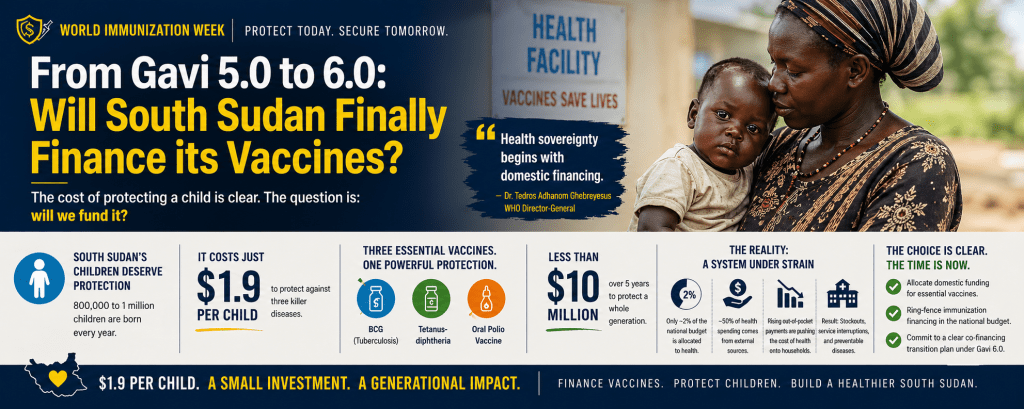
To move from affordability to prioritisation, it is important to recognise that the economics of this issue are straightforward. For approximately $1.9 per child, South Sudan can procure three essential vaccines: the BCG vaccine, the Tetanus-diphtheria vaccine, and the Oral polio vaccine. It is a question of prioritisation. Each year, the total cost of vaccinating children is estimated at under $10 million. In policy terms, this is not a question of affordability. It is a question of prioritisation.
When essential vaccines at this cost are not consistently available, the issue is not whether resources exist, but whether they are being allocated accordingly. What these points point to is a financing model under strain. For years, South Sudan’s immunisation programme has been sustained through external support, particularly from Gavi and other development partners. This model has delivered results, but it was never designed to be permanent.
The government’s own Annual Health Sector Performance Report (2024–2025) provides a clear picture of the current financing landscape. Public expenditure on health remains at approximately 2% of the national budget, significantly below the 15% benchmark set under the Abuja Declaration. At the same time, external sources account for nearly half of total health spending.
As external funding begins to plateau or decline, the expected transition to increased domestic financing has not materialized. Instead, the gap is increasingly absorbed through rising household out-of-pocket expenditures. This pattern is not unique to immunization, but its implications are particularly visible here.
Vaccines, which should be among the most protected and predictable health investments, become vulnerable when the system financing them is unstable. This is how financing gaps translate into service gaps.
The same report characterizes the health financing environment as marked by low government allocation, overreliance on external funding, and rising private expenditure. In practical terms, when financing falters, service delivery follows. Therefore, the absence of the BCG vaccine is not an isolated supply issue. It reflects a broader systemic vulnerability in which essential commodities are not adequately secured within domestic financing frameworks.
The consequences are immediate. Without BCG, newborns are exposed to severe forms of tuberculosis (TB), including TB meningitis and disseminated disease, both of which carry high mortality and long-term health implications. These are not distant risks. They are preventable outcomes.
While there is clearly a gap in health financing reform, it is important to recognize that the challenge is no longer one of policy design. Institutional structures to strengthen health financing are already in place. A Health Financing Unit has been established, technical coordination mechanisms are in place, and engagement with parliamentary processes is ongoing. However, the translation of these structures into tangible financing outcomes remains limited.
Budget allocations have not significantly increased. Planned reforms, including innovative financing mechanisms and the development of a national health insurance framework, have not been implemented. Key financing strategies remain underdeveloped or pending. In policy terms, this is an implementation gap. The architecture exists, but execution does not.
Therefore, the transition from Gavi, the Vaccine Alliance 5.0 to 6.0 presents a strategic inflection point. The ongoing in-country dialogues are not simply about reviewing past performance. They are about defining the terms of future engagement, particularly the balance between external support and domestic responsibility. The central question is no longer whether partners will continue to support South Sudan’s immunization programme. The question is whether South Sudan will progressively assume a greater role in financing it.
This aligns with broader global health policy direction. As emphasized by the World Health Organization’s Director-General, Tedros Adhanom Ghebreyesus, health sovereignty ultimately rests on domestic financing, not as an abstract principle, but as a budgetary commitment. This moment does not call for blame, nor does it diminish the critical role of development partners. It calls for alignment.
External support is most effective when it complements, rather than substitutes, domestic investment. Government financing, in turn, is essential for ensuring sustainability, predictability, and ownership. At its core, the issue is straightforward. If a country cannot consistently allocate resources for vaccines costing $1.9 per child, the constraint is not purely financial. It is strategic.
As World Immunization Week concludes, and as policymakers and partners convene in-country to shape the next phase of immunization strategy, there is a clear opportunity to move from dialogue to decision.
Financing vaccines domestically is not only a technical necessity. It is a signal of commitment to children, to health systems, and to the country’s long-term development trajectory. For a nation’s priorities are ultimately reflected in its budget. In South Sudan’s case, the cost of demonstrating that priority is both known and modest. The question now is whether it will be acted upon.


