

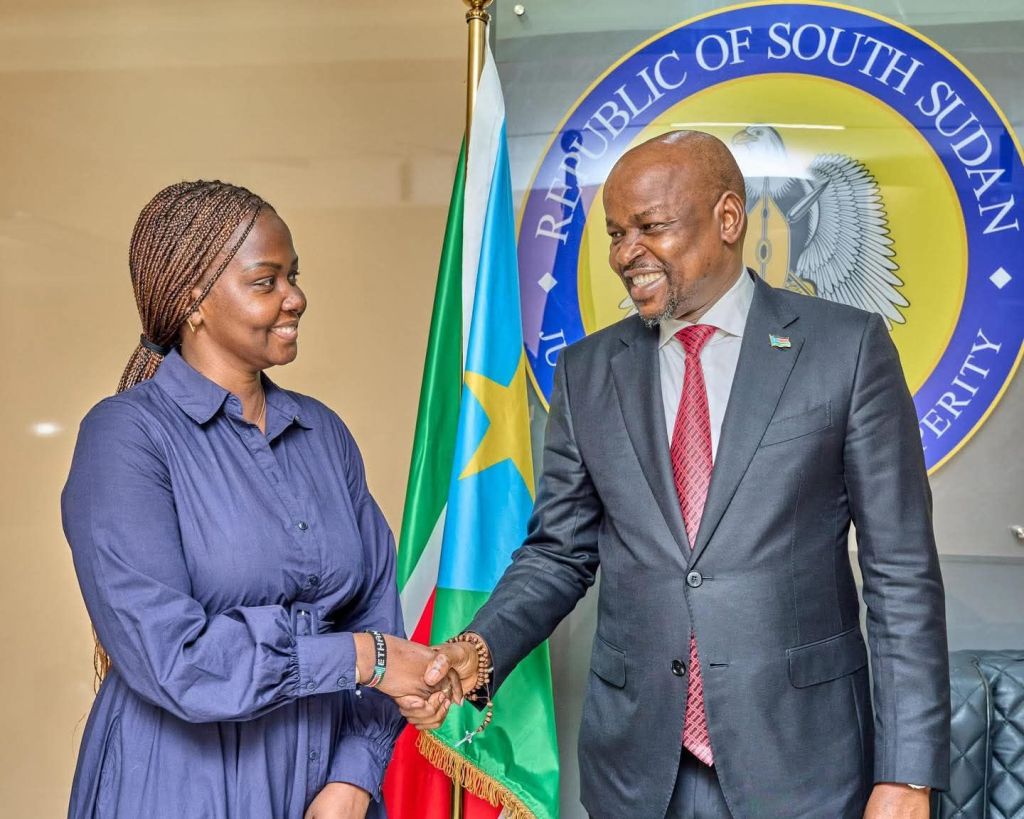
Ms. Adut Salva Kiir, the new Senior Presidential Envoy on Special Programs meeting Dr. Benjamin Bol Mel, the Vice president for the economic cluster within a week of assuming office.
On 20th August 2025, the president of the Republic of South Sudan appointed his daughter Ms. Adut Salva Kiir as the Senior Presidential Envoy on Special Programs (SPESP). Since that day the, the public has heard little beyond the fact that she is the President’s first daughter and founder of Adult Salva Kiir (ASK) foundation. Her speeches have been scarce and, when offered, only hint at fragments: that she was born in hardship, that her struggles were part of the broader liberation struggle, and that she has an economic background. Admirable, yes, but woefully inadequate. These scraps do not amount to the kind of story that inspires a generation.
Sadly, this is not unique to her case. For most appointments announced by presidential decree, the media houses limit themselves to headlines:“𝐒𝐨-𝐚𝐧𝐝-𝐬𝐨 𝐚𝐩𝐩𝐨𝐢𝐧𝐭𝐞𝐝.”Little effort is made to go further. The public is rarely given a deeper understanding of the appointee. Their academic path, their track record, their professional contributions, and their worldview are not shared. Instead, we are left with names and hometowns, as though that alone should qualify someone to lead. The result is that people forget that leadership requires more than lineage, connections, or geography. It demands competence, vision, and experience.
When the media does not probe, society pays the price. A girl watching on television, or scrolling on social media, yearns to know not only the title but the journey. What studies shaped her? What obstacles did she overcome? What mentors, disciplines, or defining moments prepared her for this role? These are the details that plant seeds of possibility. Without them, leadership is reduced to titles, not lived merit.
The absence of information does not only rob inspiration, it undermines accountability. Leadership is not just about who you are related to; it is about the qualifications, discipline, and vision you bring to a role. Without critical questions from and answers dug by the media, the public cannot assess whether a leader has the requisite skills or even the basic qualifications for the task. In failing to demand answers, both governance and the standards by which leaders are judged, are weakened.
But the silence is not the media’s alone. Those who claim to have known her since childhood, who have since been busy building support camps in her name, have offered no meaningful insight either. They too perpetuate the gap, preferring loyalty and praise over truth and detail.
And the leader herself bears responsibility. For women especially, telling one’s story comprehensively is not a luxury; it is a duty. When women ascend to high office but fail to share their journeys in ways that are authentic and complete, they deny younger generations, particularly girls a roadmap. The result is a leadership figure who feels distant, inaccessible, and uninspiring.
Leadership is not just about occupying a seat. It is about embodying a story that teaches, inspires, and sets standards. The media must do its job to probe and narrate. Leaders must embrace the duty of authentic storytelling. And as a society, we must demand both. For when stories remain untold, we do not only lose inspiration, we lose accountability, and we allow power to rest on titles alone.
 Koiti Emmily