

๐–๐ก๐ž๐ง ๐‰๐ฎ๐ฌ๐ญ๐ข๐œ๐ž ๐Ÿ๐จ๐ซ ๐ญ๐ก๐ž ๐๐จ๐ฐ๐ž๐ซ๐Ÿ๐ฎ๐ฅ ๐๐ฅ๐จ๐œ๐ค๐ฌ ๐‰๐ฎ๐ฌ๐ญ๐ข๐œ๐ž ๐š๐ง๐ ๐’๐ž๐ซ๐ฏ๐ข๐œ๐ž๐ฌ ๐Ÿ๐จ๐ซ ๐ญ๐ก๐ž ๐Ž๐ซ๐๐ข๐ง๐š๐ซ๐ฒ

This morning, the Court in Juba is set to hear the case of the now-suspended First Vice President of South Sudan, Dr. Riek Machar Teny, chairman of the Sudan Peopleโ€™s Liberation Movement in Opposition (SPLM/IO), alongside other high-profile figures accused of treason and related charges. It is a politically charged trial with weighty implications for our fragile peace. But as a citizen, one cannot help but observe that on days such as this, justice for the powerful often casts a long shadow over the ordinary.

The precise venue, whether the High Court or Freedom Hall matters less than the pattern. Both lie within Jubaโ€™s central business district, a space interwoven with vital arteries of public life. Around these venues are Juba Teaching Hospital, the University of Juba, St. Josephโ€™s Catholic Parish, the national dialysis center, and countless offices, and small businesses that serve as the backbone of the city. These are not peripheral facilities; they are lifelines. Yet when high-profile trials are underway, roads are barricaded, security personnel line the streets, and pickups bristling with armed soldiers stand ready. The atmosphere is tense, intimidating, and in many ways traumatizing to ordinary civilians who only wish to access care, education, worship, justice, or other essential services.

We have seen this before. In 2014, when the famous former political detainees were tried at the high court, access was curtailed in exactly this manner. Ordinary citizens with scheduled hearings found themselves in fear of being turned away and told their matters would have to wait. Pregnant women due for antenatal care or delivery hesitated to approach the hospital. A parent or guardian with a child in need of an urgent vaccine was likely deterred by the sight of guns. Today, patients needing dialysis will likely face the same fear of restricted access. Those who are desperate and brave will have to contend with the indignity of navigating back roads, roads barely passable even for ordinary vehicles. In these moments, the stateโ€™s solemn duty to protect life and uphold justice for all is quietly undermined.

This is not simply an inconvenience. It is a violation of fundamental rights. Access to justice is impeded when ordinary citizens are told, implicitly or explicitly, that their day in court must, or could be postponed because a more โ€œimportantโ€ case is underway. Access to health is obstructed when the atmosphere of fear keeps patients away from essential services. Access to faith and education is compromised when worshippers or students cannot safely approach their parish or university.

What is striking is the absence of communication. When the government announces trials of this magnitude, there is no prior assurance to citizens that their rights to health, justice, education, and worship will not be impeded. There are no proactive measures such as rerouting plans for patients and providers (doctors, nurses, and others), special lanes for service users, or public guidance to reduce fear. The silence is deafening, and it leaves the impression that ordinary people are expendable collateral on days when the powerful are on trial.

South Sudan must do better. High-profile trials are an inevitable part of any countryโ€™s democratic and legal evolution. But they must not come at the expense of the ordinary. Government institutions should recognize their duty of care: to ensure that, alongside announcements of such trials, there are concrete, safe, and dignified parallel measures that safeguard uninterrupted access to justice for others, to health for patients, to worship for the faithful, and to education for students.

Justice cannot be said to exist if its pursuit for a few obstructs the rights of the many. The health of our democracy and the health of our people depend on the same principle: no one should be denied access to essential services because the powerful are before the bench.

One day, South Sudan will have to confront not just how justice is dispensed for the high and mighty, but also how it is quietly denied to the ordinary when the state forgets that its first duty is to all its citizens. Until then, the barricades around our courts and Freedom Hall will stand not just as symbols of security, but also as symbols of exclusion.

๐€๐๐ฏ๐จ๐œ๐š๐ญ๐ž๐ฌโ€™ ๐‚๐ข๐ญ๐ฒ: ๐€ ๐๐ซ๐ž๐œ๐ž๐๐ž๐ง๐ญ ๐“๐ก๐š๐ญ ๐ƒ๐ž๐ฆ๐š๐ง๐๐ฌ ๐‚๐š๐ซ๐ž๐Ÿ๐ฎ๐ฅ ๐’๐œ๐ซ๐ฎ๐ญ๐ข๐ง๐ฒ

Advocates in South Sudan have long carried the important duty of defending rights when few dared, and they remain an essential pillar of our fragile democracy. Their contribution deserves recognition. Yet recognition should not come at the expense of principles that safeguard fairness, transparency, and accountability.

The governmentโ€™s recent allocation of land for an โ€œAdvocatesโ€™ City,โ€ where each advocate is to receive a plot, is therefore not simply a gesture of appreciation. It is a decision that sets precedent. In policy terms, precedents matter because they create reference points for future allocations and shape how resources are understood, distributed, and justified.

History offers important lessons. There have been precedents where the government of the day allotted land to associations and fraternities, but these allocations were typically for office premises to facilitate collective work, not for private ownership. Another example is the allocation of land in Nyakuron South during the interim government period, where legislators, army generals, and ministers were given surveyed plots upon payment. While many were able to acquire and develop the land, those unable to do so often sold their plots, leading to private transactions far removed from the original policy intent. These experiences caution us that such decisions, however well-intentioned, can evolve into outcomes that reinforce inequality and speculation rather than serve the public good.

This is why transparency is critical. In the case of the Advocatesโ€™ City, no publicly known guidelines have been communicated. If such guidelines exist, it was the duty of the Bar Association leadership to make them public, both to educate citizens and to prevent misunderstandings. Transparency in land allocation is not a courtesy, it is a governance obligation that strengthens trust in institutions.

The broader policy question is one of priorities. In a country where many families remain displaced without adequate shelter, and where most state hospitals lack land even to accommodate on-call health workers, often relying on colonial-era buildings in disrepair, the allocation of an entire โ€œcityโ€ to one profession sends a troubling signal. Land is not just property in South Sudan; it is livelihood, identity, and survival. When it is distributed as reward and for private ownership, the risks of exclusion, resentment, and conflict are heightened.

Moreover, advocates occupy a unique role in society. They are expected to hold government and elites accountable. If they are instead perceived as beneficiaries of privileged allocations, their independence and credibility may be questioned. This does not serve the profession, nor the wider public interest.

Silence around this issue compounds the challenge. The media has not raised it, civil society has barely engaged it, and professional voices remain quiet. Yet policy decisions of this magnitude should not pass unnoticed. Open debate ensures legitimacy, and without it, perceptions of favoritism will linger.

The issue is not whether lawyers deserve improved working conditions. They do, just as other professions do. The issue is how such improvements are pursued: through what process, with what safeguards, and in alignment with which national priorities.

South Sudan stands at a stage where policy decisions must reflect fairness, transparency, and equity. The Advocatesโ€™ City, if allowed to proceed without scrutiny, risks becoming a precedent that normalizes privilege rather than one that builds stronger institutions. This is why it deserves measured but serious public attention. I sincerely hope it will eventually get the measured attention it should have gotten.

International Toilet Day’s Relevance to South Sudan’s Pursuit of Peace and Security

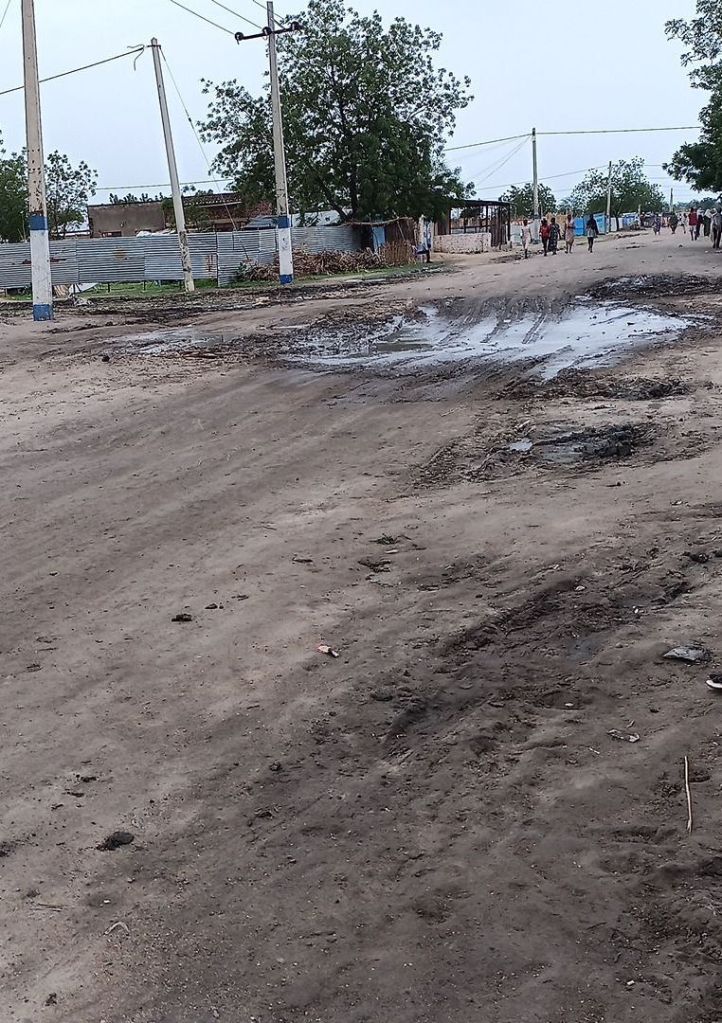
A street in Renk County, in a residential area a week after heavy rain in July 2024


This year’s International Toilet Day, 19th November, finds South Sudan grappling with a cholera outbreak that started in Renk, Upper Nile State. Since Sudan’s senseless war erupted in March 2023, Renk has been the major border town where refugees and returnees fleeing from the war arrive at and transit to refugee camps and ancestral homes respectively. Renk has also had to receive internally displaced persons from inter-communal conflicts in places like Malakal. As a result, Renk has had to suffer stress from sudden population upsurge due to influx of forced migrators.

Having lived and worked in Renk county this year (though for what I consider a short time) as a medical doctor, I witnessed first hand the water and sanitation crisis exacerbated by the influx of refugees and returnees. Although most of Renk county’s residences have ventilated pit latrines or toilets, there is normalised open defecation by children. It is not uncommon to find a child comfortably squatting in the middle of an often not busy street (with minimal movement of locomotives) and defecating what is almost always loose feces as their parent or guardian looks on.

Renk has enjoyed a piped running water system for many years as a border town but it is old and not well maintained. As a result, it cannot relay water to all homesteads that are connected to it. Consequently, for all homes in Renk town to have water, some people use donkeys with metallic 250 litre drums tied to the animals’ backs to fetch water from a point where it is easily gotten. They then distribute it at a fee to homesteads that either don’t get water from the piped system though connected to it or those that are not linked to it at all. At the time I was in Renk in July, a 20 liter jerrycan cost 400-500 South Sudanese pounds when the dollar rate was 3500 SSP to 1 United States dollar.

Renk’s soil is deeply cracking clay which makes it have low permeability thus flood-prone and takes long to dry up during the rainy season. Because clay soil is also tightly packed and difficult for water to infiltrate or move over it easily, the water tends to pool on its surface. Pools of stagnant water are therefore common in Renk during the rainy season and it’s from these with a semblance of settled water by the only tamarc road-side that car washers fetch to promote their livelihood. It is these same pools where the female anopheles mosquito that transmits malaria multiplies best.

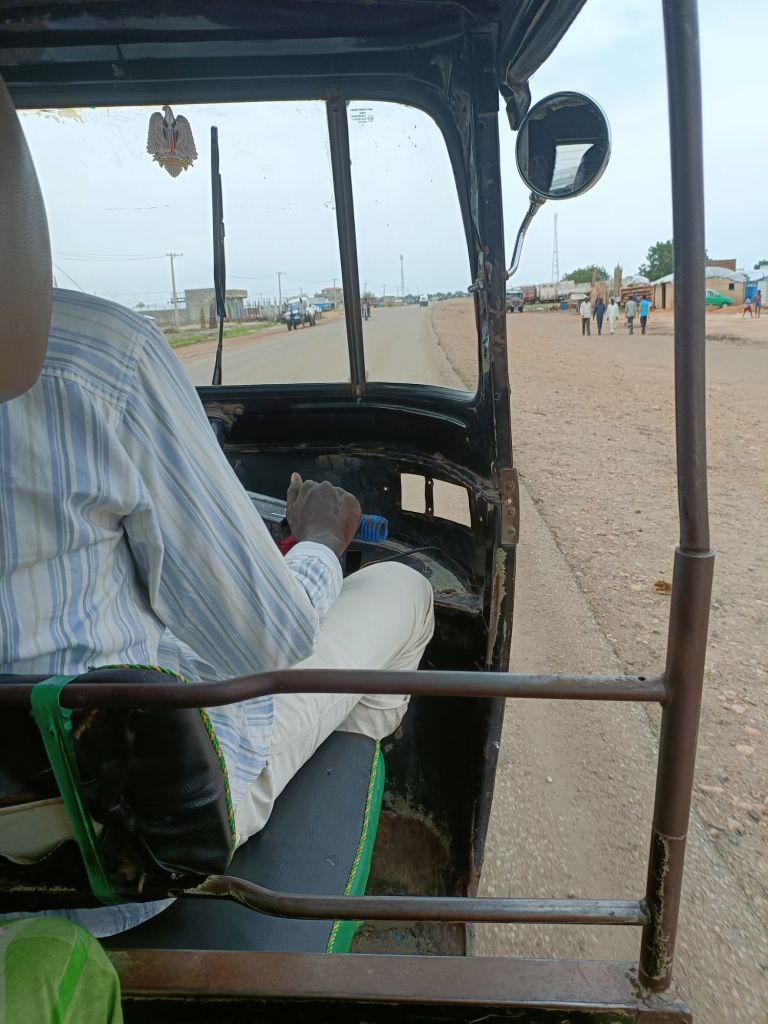
A raksha riding on the only tarmac road in Renk. Tarmac enters Renk from Sudan’s border.

Inside the refugee transit site, until August when I last checked, water pools would be common due to heavy rains. There are ventilated pit latrines but the population is often big compared to their number thus maintenance of hygiene is difficult. This exacerbates the cycle of diarrhoeal infections as houseflies multiply from the latrines, find their way to the dormitories of the refugees and food stalls just outside the transit sites. When these flies land on food that ends up being eaten, the pace is set for diarrhoeal illness to ensue. The cycle becomes vicious once the sick one with diarrhoea defecates in the open during rain as this would wash it off into the stagnant water trapping spaces that also serve as water sources for some in the community.

It is also worth mentioning that the latrines in the transit sites are not separated according to gender. As a result, in the past, some cases of attempted rape happened when women and girls went to unisex latrines only to find their perpetrators waiting for them. However, this has over the months been attenuated by one of the NGOs, ACTED, maintaining patrols all over the transit camp to guarantee the safety of all. That a water and sanitation crisis can result in sexual violence in the transit site adjacent to a town I have come to believe is one of the safest for a woman to walk on its streets is worrying. Compared with Juba, gunshots are unheard of in Renk town and its streets have lights that afforded me a lone walk in the night as late as eleven o’clock, something I cannot attempt in Juba.

To address the water hygiene challenge in Renk, Solidarite, a non-profit working in Renk has taken on water purification for both the town and the transit centers. However, in the transit centers, it is not rare to find people fighting at the water distribution points because of the long queues. Solidarite’s distribution point for the town also until August (not certain about now), wasn’t connected to the pipe system hence was one of the collection points where the metallic-tank laden donkeys would pick water from before heading for sale to the town dwellers. Often, the distributors of water don’t wash the tanks and in the process, what is supposed to have been treated water from Solidarite, is contaminated yet most consumers do not boil it before drinking.

With all the above, it is clear that Renk’s water and sanitation status is a notable prelude to not only infectious disease outbreaks like Cholera but also water-access-related conflict in the transit sites. As a clinician, it also made sense to me why most outpatient cases of children and adults attended in the transit sites were attributable to malaria and diarrheal illness.

Elsewhere in Juba, South Sudan, Eye Radio reported about a fortnight ago about people using polythene bags to ease themselves in the slummy suburb of Nyakuron East residential area. The lack of proper toilets or latrines in South Sudan is therefore a nationwide problem that must be addressed holistically.


This year’s theme for International Toilet Day; “Toilets – a place for peace” is therefore very relevant to South Sudan as she grapples with her most recent major public health threat; cholera, which I argue, can be linked to the effects of Sudan’s war on South Sudan. This year’s theme emphasises the relationship between sanitation and peace and security of communities. With a cholera outbreak that is now spread to other parts of the northern South Sudan, in a country whose rank on the peace and security index is wanting, Renk’s people are not at peace and by extension in the spirit of Ubuntu (I am, because you are), neither are any others across South Sudan.

As we mark this International Toilet Day, let’s recognise that the pursuit of peace and security in not only South Sudan but also the horn of Africa where Sudan falls, is inextricably linked to alleviation ofย  the water and sanitation crisis in the same region. More investments by development and humanitarian partners should be intentional in embracing a humanitarian-development-peace nexus lense when addressing the WASH crisis in the horn of Africa and in particular South Sudan that is home to many refugees from Sudan.

Wishing you a thoughtful International Toilet Day.

Free Labour in Love?

“Asha, I am doing laundry and cleaning up at Brian’s”, said Susan as she explained why she wouldn’t show up for one of their friend’s last funeral prayer.

Ever since Susan started seeing Brian, just weeks into the relationship, she took over house management duties at Brian’s bedsitter apartment in Juba na Bari. Doing laundry, cleaning up, shopping and cooking some meals are now synonymous with Susan’s presence at Brian’s house on weekends. She was raised with the knowledge that these are duties of a woman to a man she loves. That it is the way to prove that she is marriage material, one who cares and is prepared to be a homemaker.

Unbeknown to her, during the weekdays, Sarah is another who shows up at Brian’s as a date. Sarah spends at least two nights during weekdays but does not do anything related to house chores. In fact, when Sarah visits, Brian ensures food is delivered by his most trusted rider from Sarah’s favourite restaurants. Sarah looks polished compared to Susan and seems to come from a bourgeois background. She is well travelled. She arrives at Brian’s in her personal Toyota Harrier while Susan is almost always dropped off by a boda boda if Brian does not pick her up. She can afford a car but fears that owning one will make her less attractive to Brian.

You must be wondering where I am heading with this. Stay with me. For this is how many young men in Sub Saharan Africa benefit from unpaid labour offered in the name of love and commitment by young women who are socialised to do this in their upbringing. Most of these young men were raised in households where these duties are done by females. In these same households, the definition of wife material befits Susan, not Sarah. Yet Brian though grew up in these households, he has also as a working adult travelled the world and seen women in other places like Netherlands behave as Sarah. He admires them but is also stuck with what was hammered into his head from childhood. That a good woman must do his laundry, prepare his meals and so on.

Brian likes Susan’s ability to make his place homely in ways no hired house manager can. That he even doesn’t have to pay her for it, makes him want to keep her. No wonder, when Susan is upset and declines to show up over the weekends, Brian begs her until she shows up. Not because he really loves her and is decided about settling with her, but precisely because she provides free yet good labour that he needs for his apartment to be habitable to his taste. Poor Susan, she offers free labour in love. She truly loves him but was raised with the notion that she has to prove it through such labour.

Meanwhile, Brian enjoys Sarah’s presence. They talk about travel, work place politics, projects and current affairs. Of course there is time for that and she has no exhaustion that prevents her from indulging in conversations. Susan is often too tired to talk much. Every weekend, in addition to house chores, she affords Brian unreserved intimate access to her body. That’s the much Brian knows about her. He hardly discusses with her how work and her personal development is progressing. But he does with Sarah. Does Susan offer free Labour in love? I think yes. Will Brian marry her as she hopes?, I highly doubt. May the Susans of Juba na Bari wake up. It is 21st century and there must be an end to socialisation of acceptance of exploitation of labour in the name of love. With more Sarahs, we can see a clearer path to ending this exploitation and entitlement of young men. Susan’s is not a labour of love.