

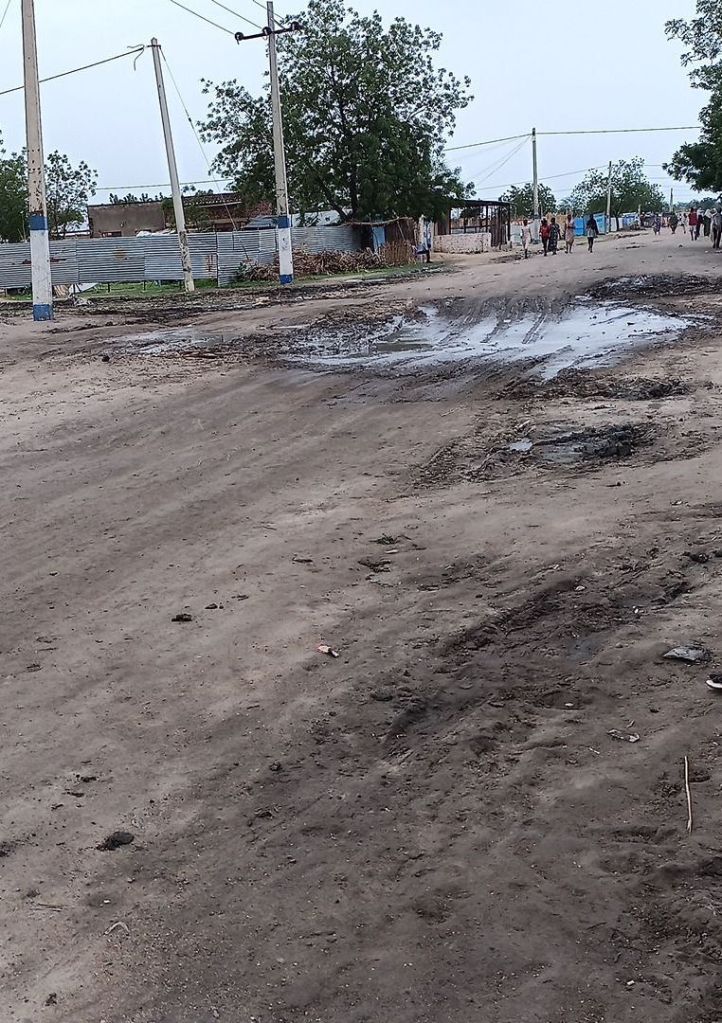
A street in Renk County, in a residential area a week after heavy rain in July 2024
This year’s International Toilet Day, 19th November, finds South Sudan grappling with a cholera outbreak that started in Renk, Upper Nile State. Since Sudan’s senseless war erupted in March 2023, Renk has been the major border town where refugees and returnees fleeing from the war arrive at and transit to refugee camps and ancestral homes respectively. Renk has also had to receive internally displaced persons from inter-communal conflicts in places like Malakal. As a result, Renk has had to suffer stress from sudden population upsurge due to influx of forced migrators.
Having lived and worked in Renk county this year (though for what I consider a short time) as a medical doctor, I witnessed first hand the water and sanitation crisis exacerbated by the influx of refugees and returnees. Although most of Renk county’s residences have ventilated pit latrines or toilets, there is normalised open defecation by children. It is not uncommon to find a child comfortably squatting in the middle of an often not busy street (with minimal movement of locomotives) and defecating what is almost always loose feces as their parent or guardian looks on.
Renk has enjoyed a piped running water system for many years as a border town but it is old and not well maintained. As a result, it cannot relay water to all homesteads that are connected to it. Consequently, for all homes in Renk town to have water, some people use donkeys with metallic 250 litre drums tied to the animals’ backs to fetch water from a point where it is easily gotten. They then distribute it at a fee to homesteads that either don’t get water from the piped system though connected to it or those that are not linked to it at all. At the time I was in Renk in July, a 20 liter jerrycan cost 400-500 South Sudanese pounds when the dollar rate was 3500 SSP to 1 United States dollar.
Renk’s soil is deeply cracking clay which makes it have low permeability thus flood-prone and takes long to dry up during the rainy season. Because clay soil is also tightly packed and difficult for water to infiltrate or move over it easily, the water tends to pool on its surface. Pools of stagnant water are therefore common in Renk during the rainy season and it’s from these with a semblance of settled water by the only tamarc road-side that car washers fetch to promote their livelihood. It is these same pools where the female anopheles mosquito that transmits malaria multiplies best.
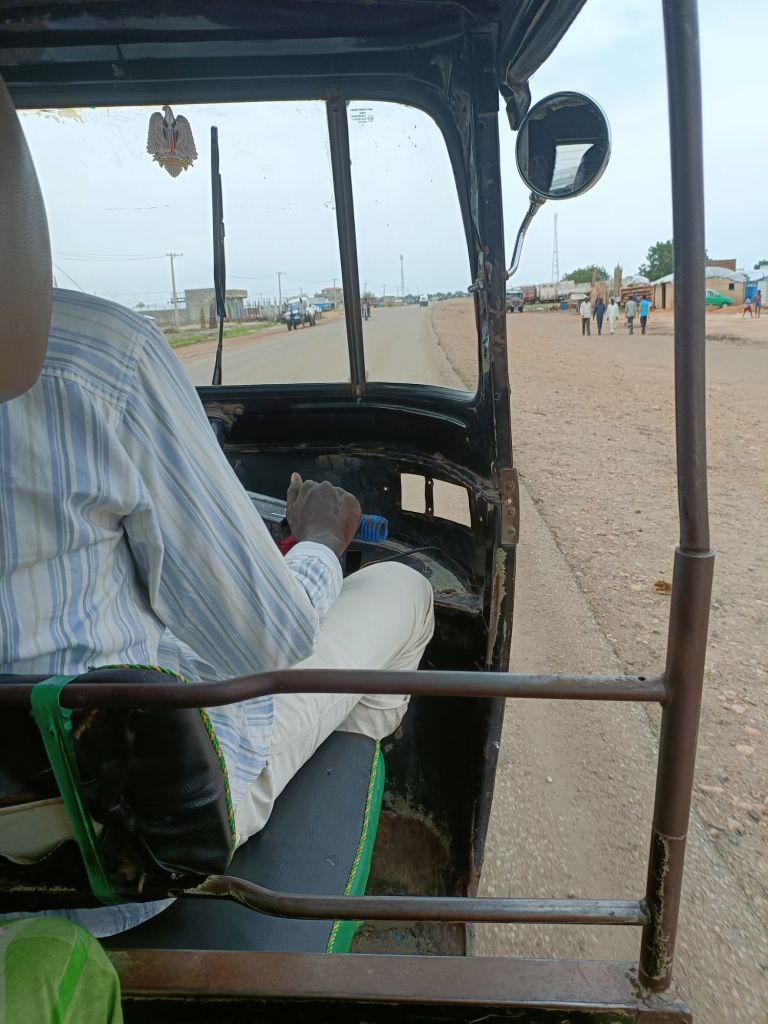
A raksha riding on the only tarmac road in Renk. Tarmac enters Renk from Sudan’s border.
Inside the refugee transit site, until August when I last checked, water pools would be common due to heavy rains. There are ventilated pit latrines but the population is often big compared to their number thus maintenance of hygiene is difficult. This exacerbates the cycle of diarrhoeal infections as houseflies multiply from the latrines, find their way to the dormitories of the refugees and food stalls just outside the transit sites. When these flies land on food that ends up being eaten, the pace is set for diarrhoeal illness to ensue. The cycle becomes vicious once the sick one with diarrhoea defecates in the open during rain as this would wash it off into the stagnant water trapping spaces that also serve as water sources for some in the community.
It is also worth mentioning that the latrines in the transit sites are not separated according to gender. As a result, in the past, some cases of attempted rape happened when women and girls went to unisex latrines only to find their perpetrators waiting for them. However, this has over the months been attenuated by one of the NGOs, ACTED, maintaining patrols all over the transit camp to guarantee the safety of all. That a water and sanitation crisis can result in sexual violence in the transit site adjacent to a town I have come to believe is one of the safest for a woman to walk on its streets is worrying. Compared with Juba, gunshots are unheard of in Renk town and its streets have lights that afforded me a lone walk in the night as late as eleven o’clock, something I cannot attempt in Juba.
To address the water hygiene challenge in Renk, Solidarite, a non-profit working in Renk has taken on water purification for both the town and the transit centers. However, in the transit centers, it is not rare to find people fighting at the water distribution points because of the long queues. Solidarite’s distribution point for the town also until August (not certain about now), wasn’t connected to the pipe system hence was one of the collection points where the metallic-tank laden donkeys would pick water from before heading for sale to the town dwellers. Often, the distributors of water don’t wash the tanks and in the process, what is supposed to have been treated water from Solidarite, is contaminated yet most consumers do not boil it before drinking.
With all the above, it is clear that Renk’s water and sanitation status is a notable prelude to not only infectious disease outbreaks like Cholera but also water-access-related conflict in the transit sites. As a clinician, it also made sense to me why most outpatient cases of children and adults attended in the transit sites were attributable to malaria and diarrheal illness.
Elsewhere in Juba, South Sudan, Eye Radio reported about a fortnight ago about people using polythene bags to ease themselves in the slummy suburb of Nyakuron East residential area. The lack of proper toilets or latrines in South Sudan is therefore a nationwide problem that must be addressed holistically.
This year’s theme for International Toilet Day; “Toilets – a place for peace” is therefore very relevant to South Sudan as she grapples with her most recent major public health threat; cholera, which I argue, can be linked to the effects of Sudan’s war on South Sudan. This year’s theme emphasises the relationship between sanitation and peace and security of communities. With a cholera outbreak that is now spread to other parts of the northern South Sudan, in a country whose rank on the peace and security index is wanting, Renk’s people are not at peace and by extension in the spirit of Ubuntu (I am, because you are), neither are any others across South Sudan.
As we mark this International Toilet Day, let’s recognise that the pursuit of peace and security in not only South Sudan but also the horn of Africa where Sudan falls, is inextricably linked to alleviation of the water and sanitation crisis in the same region. More investments by development and humanitarian partners should be intentional in embracing a humanitarian-development-peace nexus lense when addressing the WASH crisis in the horn of Africa and in particular South Sudan that is home to many refugees from Sudan.
Wishing you a thoughtful International Toilet Day.

 Koiti Emmily